
Main page content
Testo 330 Advanced Combustion Analyzer Review: Field-Tested Analysis for Technicians
Executive Summary
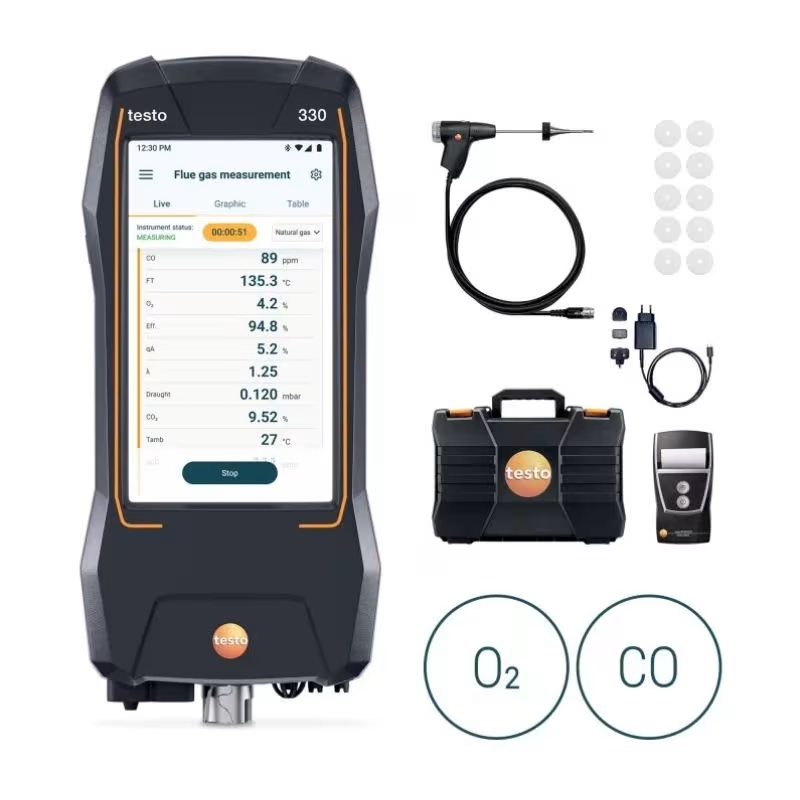
The Testo 330 Advanced Flue Gas Analyzer is a modern combustion diagnostics tool designed for HVAC service technicians, boiler mechanics, and commercial burner specialists. It replaces traditional manual testing with fast digital measurements of oxygen, carbon monoxide, stack temperature, draft, and combustion efficiency. The primary question every technician asks before buying a major diagnostic tool is straightforward. Will this instrument help me diagnose or fix problems faster, accurately, safely, and reliably, and does it justify the investment?
In field operations, the Testo 330 Combustion Analyzer delivers measurable time savings. Integrated automatic zeroing allows technicians to power up the unit while the probe remains inside the flue pipe. This feature eliminates unnecessary ladder climbs on rooftop units and tall mechanical room setups. High carbon monoxide levels often ruin electrochemical sensors in standard analyzers. The Testo 330 protects sensors using automatic fresh air dilution pumps. The unit measures high carbon monoxide concentrations up to 40000 ppm without damaging sensors. Integrated Bluetooth connectivity syncs live diagnostic data directly to the Testo Smart App. Service technicians can generate PDF customer reports and email them before packing up tools. The high initial purchase cost represents a real investment. However, extended sensor lifespan, reduced downtime, and professional digital reports make the Testo 330 a highly effective investment for busy heating professionals.
AZ Testers Technician Score
- Performance: 9.2 / 10
- Accuracy: 9.5 / 10
- Ease of Use: 9.0 / 10
- Durability: 8.8 / 10
- Features: 9.4 / 10
- Safety: 9.6 / 10
- Value: 8.5 / 10
Overall Score: 9.2 / 10 — AZ Testers Recommended
Quick Evaluation Summary
- Best For: Residential and commercial HVAC technicians, boiler specialists, and industrial combustion service personnel performing commissioning, seasonal maintenance, and emergency troubleshooting.
- Best Feature: Fresh air sensor dilution protection that extends carbon monoxide sensor life and enables stack zeroing without probe removal.
- Main Weakness: Replacement cost for electrochemical sensors and specialized accessories is higher than basic budget analyzers.
- Upgrade Option: Commercial technicians handling large modulation burners or strict emission logging should choose kit variant 0564 3300 22 with integrated nitric oxide sensor capability.
Key Specifications At-A-Glance
| Parameter / Spec | Manufacturer Specifications | Service Technicians Field Impact |
|---|---|---|
| Display and Interface | 5.5 inch color IPS touchscreen, 1280 x 720 resolution | High visibility display works well in dark basements. Touchscreen operates smoothly even with standard work gloves. |
| CO Measurement | 0 to 10000 ppm (up to 40000 ppm with active dilution protection) | Prevents sensor burnout during severe incomplete combustion events on cracked heat exchangers or clogged oil nozzles. |
| O2 Measurement | 0 to 21.0 Vol.% with ±0.2 Vol.% accuracy | Delivers instant excess air calculations. Enables precise burner tuning across high and low fire modulation cycles. |
| NO Measurement (Optional) | 0 to 3000 ppm with ±5 ppm accuracy (variant 0564 3300 22) | Allows commercial mechanics to verify environmental compliance and calculate total NOx output on industrial boilers. |
| Flue Draft Measurement | -4.00 to +16.00 inH2O (-9.99 to +40 hPa) | Replaces separate digital draft gauges. Measures draft and pressure drops in heat exchangers with fine resolution. |
| Flue Gas Temperature | -40°F to 2192°F (-40°C to 1200°C) | Long thermocouple shaft withstands high heat in heavy commercial stacks and process heaters without thermal degradation. |
| Zeroing Phase | Automatic fresh air zeroing without probe removal | Saves ten to fifteen minutes per call. No need to pull probes out of hot stacks or high elevation exhaust vents. |
| Battery Life and Power | Up to 10 hours runtime, USB-C rechargeable battery | Runs through an entire multi-job service shift on a single charge. USB-C charging allows power bank charging inside the truck. |
| Data and Wireless | Bluetooth 5.0 connection to Testo Smart App | Creates professional digital PDF reports on site. Technicians email test results to building owners before leaving jobs. |
Product Variant Comparison
| Product Number | Kit Configuration and Included Sensors | Included Accessories | Primary Field Application |
|---|---|---|---|
| 0564 3300 20 | Testo 330 Kit 1: Oxygen (O2) and Carbon Monoxide (CO) sensors (up to 20000 ppm) | 7 inch flue gas probe, particle filter pack, USB-C power supply, rugged carrying case | Standard residential HVAC service, light commercial furnace inspection, and routine boiler tuning. |
| 0564 3300 21 | Testo 330 Kit 2: Oxygen (O2) and Carbon Monoxide (CO) sensors (up to 20000 ppm) | Bluetooth thermal printer, 7 inch flue gas probe, particle filter pack, USB-C power supply, hard case | Residential and commercial service teams requiring hardcopy thermal receipts for physical customer work orders. |
| 0564 3300 22 | Testo 330 Kit 3: Oxygen (O2), Carbon Monoxide with H2 compensation (up to 40000 ppm), Nitric Oxide (NO) sensors | Bluetooth thermal printer, 7 inch modular probe, spare filters, USB-C charger, system case | Commercial boiler technicians, industrial combustion specialists, and facility engineers measuring NOx emissions. |
Pro Tip for Commercial Technicians
Commercial combustion systems demand higher measurement headroom than residential equipment. Unregulated commercial burners can produce carbon monoxide spikes above 10000 ppm during cold startups or air inlet damper failures. Selecting product variant 0564 3300 22 gives you hydrogen-compensated carbon monoxide measurement along with nitric oxide detection. Hydrogen compensation prevents false high carbon monoxide readings caused by unburned raw fuel gases in high efficiency boilers. Furthermore, active sensor dilution ensures your high concentration readings remain accurate without saturating the sensor chamber.
In-The-Field Performance and Work Analysis
Evaluating test instruments requires looking beyond product datasheets. Service technicians need equipment that withstands dirt, oil, dropped tools, extreme weather, and continuous daily use. Below is an evaluation of how the Testo 330 performs inside actual mechanical rooms and service vehicles.
Touchscreen and Ergonomics
Older flue gas analyzers relied on physical buttons and slow scrolling lists. The Testo 330 uses a 5.5 inch high definition touchscreen. The screen interface operates similarly to a modern smartphone. Menu structures allow technicians to switch between main combustion parameters, flue draft, differential pressure, and gas pipe tightness tests with simple finger swipes.
Working in poorly lit boiler rooms or bright outdoor rooftops presents display challenges. The high contrast IPS display remains readable under direct sunlight and dark basement corners. Graphical measurement curves show real-time combustion stability. You can observe Oxygen, Carbon Dioxide, and stack temperature settle visually before capturing final readings. The screen responds accurately to fingertips even when wearing light nitrile or work gloves.
Housing Durability and Included Key Parts
The exterior of the Testo 330 features rubberized protective armor. The casing absorbs light drops and impacts typical of active job sites. Strong rear magnets secure the instrument firmly to sheet metal furnace jackets and steel boiler casings. This hands-free operation keeps display screens at eye level while hands remain free to adjust gas valves or air shutters.
The flue gas probe connects to the main unit using a sturdy locking connector. Internal water traps prevent flue gas condensate from entering internal sensor chambers. An integrated fill line alerts the technician when condensation needs draining. Filter housings use clear windows, allowing fast visual checks for soot accumulation. Replacing dirty particle filters requires no hand tools and takes under thirty seconds.
Real-Time Work and Analytical Capabilities
The central question for service technicians is speed and accuracy. Standard analyzers require fresh air zeroing in ambient air before inserting the probe into the flue stack. If a system cycles off or requires re-testing, traditional probes must be pulled out to re-zero. The Testo 330 uses a second internal pump for automatic zeroing. Technicians can leave the flue probe positioned inside the vent stack while the analyzer draws clean ambient air through a secondary intake port. This capability saves significant time when troubleshooting intermittent burner lockouts.
Sensor protection represents another key advantage. High levels of carbon monoxide can destroy standard electrochemical sensors. When carbon monoxide readings exceed standard thresholds, the analyzer automatically engages an internal dilution pump. Fresh air mixes with flue gas to reduce gas concentration over the sensor face. The analyzer calculates true stack concentration accurately up to 40000 ppm without damaging sensors or causing extended recovery drift.
Data Management and Customer Reports
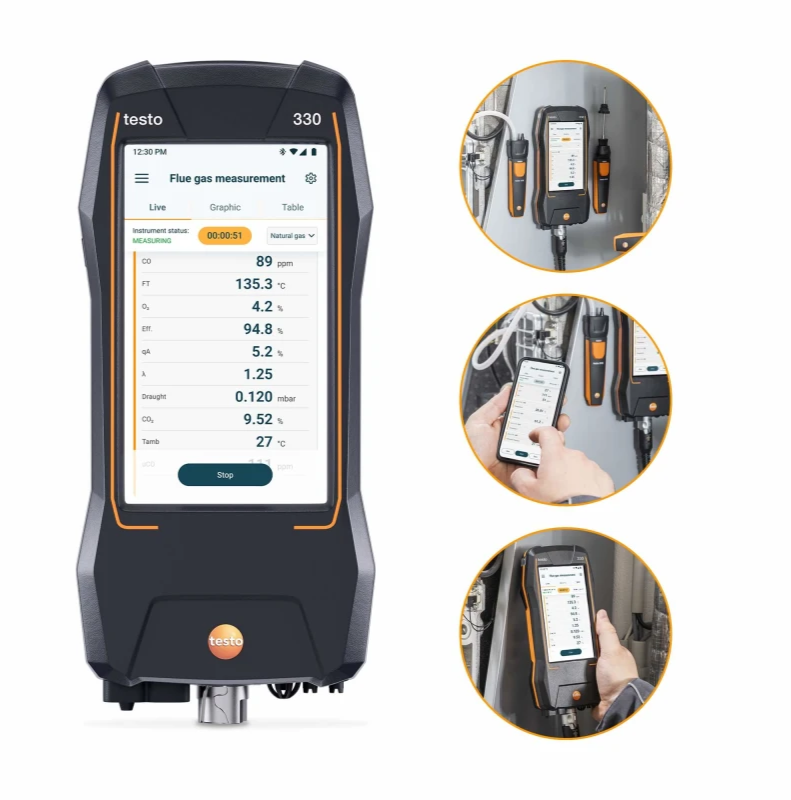
Modern HVAC service demands detailed documentation. Property managers and homeowners expect clear diagnostic proof before approving major repairs. The Testo 330 connects via Bluetooth to the Testo Smart App on Android and iOS devices.
During testing, your smartphone acts as a second display screen. Technicians can perform burner adjustments while monitoring live values on their phone several feet away. Once testing completes, the app generates a digital PDF report containing customer information, combustion efficiency figures, excess air ratios, stack temperature, and flue gas carbon monoxide levels. Reports can be emailed instantly to home owners, commercial building managers, or service managers. For technicians working in locations without mobile signal, the optional Bluetooth printer produces hardcopy printouts to staple directly to invoices.
Advantages and Limitations
Advantages (Pros)
- Automatic In-Stack Zeroing: Keeps probes secured inside exhaust stacks during startup zeroing cycles, reducing setup labor.
- Active Sensor Dilution: Protects carbon monoxide sensors against high concentration burnout up to 40000 ppm, extending sensor operating life.
- High Resolution Touch Display: Intuitive smartphone style menus and graphical data plotting simplify diagnostic interpretation.
- Comprehensive App Connectivity: Generates, stores, and emails professional customer PDF reports directly from mobile devices on site.
- Multi-Parameter Capabilities: Performs flue combustion analysis, stack draft, differential pressure, and ambient carbon monoxide monitoring in one unit.
Limitations (Cons)
- Higher Initial Cost: Base price ranges from 2495 dollars to 4195 dollars depending on sensor kit selection, requiring clear business ROI.
- IP40 Enclosure Rating: While ruggedized against mechanical drops, the unit lacks full water immersion or heavy rain waterproofing.
- Sensor Maintenance Expenses: Replacement electrochemical sensors represent an ongoing operational maintenance expense every few years.
Technician Focused FAQs
Question 1: Can I leave the flue gas probe inside the stack during instrument startup?
Answer: Yes. The Testo 330 features an automatic zeroing system utilizing a secondary fresh air pump. Clean ambient air draws across sensors during zeroing even while the probe shaft remains anchored inside an active exhaust stack. This eliminates the requirement to remove and reinsert probes between test cycles.
Question 2: How does automatic carbon monoxide dilution protect internal sensors?
Answer: When carbon monoxide concentrations exceed standard sensor thresholds, an internal dilution pump triggers automatically. The pump injects measured fresh ambient air into the sample stream to dilute gas concentration over the sensor surface. The internal processor calculates exact actual flue stack concentration while protecting electrochemical sensor elements from saturation.
Question 3: What happens if flue condensate moisture enters the analyzer?
Answer: The analyzer features an integrated condensate trap located ahead of internal sensors. Moisture collects inside a clear housing equipped with a max fill indicator line. If water reaches maximum level, technicians can empty the trap using a rubber plug. Particle filters protect internal gas lines from liquid drops and soot contamination.
Question 4: Do I need to buy the optional Bluetooth thermal printer?
Answer: No. The printer is optional. Service technicians using smartphones or tablets can send digital PDF reports directly via email or text through the Testo Smart App. However, commercial techs servicing facilities that demand immediate physical paper receipts attached to service tags will benefit from purchasing printer kits 0564 3300 21 or 0564 3300 22.
Question 5: How often do the sensors require calibration or replacement?
Answer: Electrochemical sensors typically last between three to five years depending on annual job volume and exposure levels. Active dilution protection significantly extends carbon monoxide sensor life compared to standard analyzers. Annual factory calibration is recommended to ensure precise diagnostic accuracy for utility compliance work.
Final Technician Verdict
Verdict: Highly Recommended for Professional Heating and Commercial Technicians
The Testo 330 Advanced Flue Gas Analyzer answers the essential service question with confidence. It enables technicians to diagnose combustion faults faster, more accurately, and safer than entry-level testing tools. Features such as in-stack automatic zeroing and active sensor dilution directly solve daily field frustrations. They prevent sensor burnout and eliminate wasted setup time.
While an initial investment between 2495 dollars and 4195 dollars is higher than basic combustion meters, the reduction in billable setup time, extended sensor lifespans, and instant PDF customer reporting provide clear business value. For serious residential HVAC mechanics, commercial boiler technicians, and facility maintenance engineers, the Testo 330 is an outstanding diagnostic asset that quickly pays for itself on the truck.